Thursday, November 15, 2012

Identification of Neurons Regulating Energy Expenditure


By:  Dr. Coni Horndli PhD.

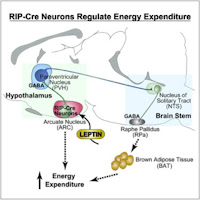
This recent study in Cell from Brad Lowell's group reveals novel circuits in the arcuate nucleus of the hypothalamus that selectively drive energy expenditure.  The authors integrate genetic and electrophysiological approaches with studies of metabolism and neuronal circuit mapping to reveal a defined population of GABAergic neurons that regulate brown fat and energy expenditure.  It remarkable to see such potent neural control over these aspects of physiology.

The authors use an elegant double-labeling method to reveal functional neuronal connectivity between RIP-Cre ARC - PVH - NTS neurons. First, a Cre-dependent virus, which expresses a channelrhodopsin-mCherry fusion protein (AAV-Flex-ChR2(H134R)-mCherry) was stereotaxically injected in the ARC of RIP-Cre mice. Second, retrograde green fluorescent beads were injected into the NTS of the same mice. Electrophysiological recordings specifically showed light-evoked IPSCs in bead+ PVH neurons.

In this study, a synthetic receptor was expressed in RIP-Cre mice and activated by the pharmacological compound CNO. Neuronal activity in response to CNO and later leptin were recorded in cultured brain slices. It would be interesting to see whether the same neuronal responses can be elicited using an in vivo approach.

In the ARC, only 30% of RIP-Cre neurons showed an excitatory response to leptin, while 35% of ARC RIP-Cre neurons were inhibited. If and how ARC neurons exhibiting these differential responses integrate into one circuit and or what the role of leptin-inhibited ARC RIP-Cre neurons is in regulating energy expenditure is not clear at this point. Also, I am wondering how, where and when AgRP, which reside in the ARC, project to the PVH and are also GABAergic but inhibit energy expenditure and food intake interplay in the RIP-Cre ARC - PVH - NTS circuitry.


REFERENCE AND ABSTRACT:


GABAergic RIP-Cre Neurons in the Arcuate Nucleus Selectively Regulate Energy Expenditure
Dong Kong, Qingchun Tong, Chianping Ye, Shuichi Koda, Patrick M. Fuller, Michael J. Krashes, Linh Vong, Russell S. Ray, David P. Olson, and Bradford B. Lowell


SUMMARY

Neural regulation of energy expenditure is incompletely understood. By genetically disrupting GABAergic transmission in a cell-specific fashion, and by combining this with selective pharmacogenetic activation and optogenetic mapping techniques, we have uncovered an arcuate-based circuit that selectively drives energy expenditure. Specifically, mice lacking synaptic GABA release from RIP-Cre neurons have reduced energy expenditure, become obese and are extremely sensitive to highfat diet-induced obesity, the latter due to defective diet induced thermogenesis. Leptin’s ability to stimulate thermogenesis, but not to reduce feeding, is markedly attenuated. Acute, selective activation of arcuate GABAergic RIP-Cre neurons, which monosynaptically innervate PVH neurons projecting to the NTS, rapidly stimulates brown fat and increases energy expenditure but does not affect feeding. Importantly, this response is dependent upon GABA release from RIP-Cre neurons. Thus, GABAergic RIP-Cre neurons in the arcuate selectively drive energy expenditure, contribute to leptin’s stimulatory effect on thermogenesis, and protect against diet-induced obesity.
Left: Graphical abstract


Right: Diagram showing ChR2/retrograde double-injection in RIP-Cre transgenic mouse brain.
 

Thursday, November 1, 2012

Nematocin; identification of  a C. elegans peptide neurotransmitter with structural and functional homology to vertebrate vasotocin and vasopressin/oxytocin.

By:  Dr. Paul Bonthuis PhD.
Two simultaneous reports by Garrison et al. and Beets et al. in last week's issue of Science discovered a C. elegans peptide neurotransmitter, and two cognate receptors, with genetic, structural, and functional similarity to the mammalian oxytocin/vasopressin (and non-mammalian vertebrate vasotocin) signaling systems.  In mammals, oxytocin and vasopressin are structurally similar octomeric neuropeptides that are secreted from the pituitary and have wide ranging effects on physiology and complex behaviors, including many social behaviors.  For example, these molecules have been linked to pair-bonding and monogamous behaviors in voles. Amazingly, similar to the roles of oxytocin/vasopressin, the 11-mer C. elegans peptide "neurotocin", and the genes for the receptors ntr-1 and ntr-2, display sexually dimorphic expression in the C. elegans nervous system and were proved to play important roles in reproductive and learned foraging behaviors of the worm.  The finding of an ancient neural regulator in the structurally simple nervous system of the worm that has conserved functional roles on behavior with the structural complex nervous systems of vertebrates, has the potential to reveal fundamental mechanistic insights on the neural regulation of complex behaviors.  For a thorough explanation of the implications of the discoveries, read "The Mood of the Worm" by Scott Emmons in the same issue of Science.


REFERENCES and ABSTRACTS:
Science 26 October 2012:
Vol. 338 no. 6106 pp. 540-543
DOI: 10.1126/science.122620
Oxytocin/Vasopressin-Related Peptides Have an Ancient Role in Reproductive Behavior
    1.    Jennifer L. Garrison,
    2.    Evan Z. Macosko,
    3.    Samantha Bernstein,
    4.    Navin Pokala,
    5.    Dirk R. Albrecht,
    6.    Cornelia I. Bargmann

Abstract
Many biological functions are conserved, but the extent to which conservation applies to integrative behaviors is unknown. Vasopressin and oxytocin neuropeptides are strongly implicated in mammalian reproductive and social behaviors, yet rodent loss-of-function mutants have relatively subtle behavioral defects. Here we identify an oxytocin/vasopressin-like signaling system in Caenorhabditis elegans, consisting of a peptide and two receptors that are expressed in sexually dimorphic patterns. Males lacking the peptide or its receptors perform poorly in reproductive behaviors, including mate search, mate recognition, and mating, but other sensorimotor behaviors are intact. Quantitative analysis indicates that mating motor patterns are fragmented and inefficient in mutants, suggesting that oxytocin/vasopressin peptides increase the coherence of mating behaviors. These results indicate that conserved molecules coordinate diverse behavioral motifs in reproductive behavior.                    


Science 26 October 2012:
Vol. 338 no. 6106 p. 469
DOI: 10.1126/science.1225996

Vasopressin/Oxytocin-Related Signaling Regulates Gustatory Associative Learning in C. elegans
    1.    Isabel Beets1,
    2.    Tom Janssen1,
    3.    Ellen Meelkop1,*,
    4.    Liesbet Temmerman1,
    5.    Nick Suetens1,
    6.    Suzanne Rademakers2,
    7.    Gert Jansen2,
    8.    Liliane Schoofs1,†

Abstract
Vasopressin- and oxytocin-related neuropeptides are key regulators of animal physiology, including water balance and reproduction. Although these neuropeptides also modulate social behavior and cognition in mammals, the mechanism for influencing behavioral plasticity and the evolutionary origin of these effects are not well understood. Here, we present a functional vasopressin- and oxytocin-like signaling system in the nematode Caenorhabditis elegans. Through activation of its receptor NTR-1, a vasopressin/oxytocin-related neuropeptide, designated nematocin, facilitates the experience-driven modulation of salt chemotaxis, a type of gustatory associative learning in C. elegans. Our study suggests that vasopressin and oxytocin neuropeptides have ancient roles in modulating sensory processing in neural circuits that underlie behavioral plasticity.               

Wednesday, October 12, 2011

NYSCF-Robertson Neuroscience Investigator

Good news!  The Gregg Lab is happy to announce that Christopher Gregg has been named a NYSCF-Robertson Neuroscience Investigator by the New York Stem Cell Foundation.  The award brings $1.5 million in research funding over 5 years for high risk, high impact research projects.  The four winners selected this year from the US, UK and Canada, were announced this week at a gala dinner event held at Lincoln Center in New York City.  The event brought together scientific leaders in the stem cell and neuroscience fields with local philanthropists and community leaders.  New York Mayor Michael Bloomberg, who has been a strong supporter of scientific research, spoke at the event.

In addition to Christopher Gregg, the neuroscience winners this year include:

Ed Boyden: A pioneer in the field of optogenetics at MIT.
Takaki Komiyama:  A pioneer in the use of two-photon imaging to study neuronal activity and motor learning in the brain of awake behaving animals at UCSD.
Gaby Maimon:  A leader in the development of approaches to record neuronal activity in awake and behaving fruit flies to uncover neural processes regulating decision making.  He is located at Rockefeller University.

Big thanks to NYSCF and all of the great people who support this powerful initiative! 

Learn more here:  New York Stem Cell Foundation

Friday, July 29, 2011

Writing a Research Proposal - Quick Tips

Great science writing might be described as a strange form of poetry that brings beautiful ideas to life with piercing clarity and purpose.  Getting good at this is a career long endeavour.  PhD students write for awards, for preliminary exams and for manuscripts to be published.  Postdocs write for journal manuscripts, fellowships, awards, and ultimately, their own grants!  Professors write for everything from grants to journal manuscripts to textbooks.  Write…write…write.  Communication is a central component of a science career.  This article is about how to write a research proposal, which is often done to get money from funding agencies, and is therefore, very important.  Here, I include useful tips I have gathered from experienced and successful colleagues.


A Basic Outline for a Five Page Research Proposal

Some General Comments:
Your proposal must present a great idea to address an important and interesting problem.  Be Original.  Focus the proposal on one clear central problem such that the Aims logically work towards addressing that central problem and the whole proposal logically adheres to a major theme.  Break each aim into separate goals that address the proposed aim.  For each goal, clearly lay out (1) the Rational (background logic), (2) the Problem (what is not known), (3) the Approach (how you will solve the problem), (4)  What you expect to learn and why it is significant, (5) A final transition sentence that logically prepares the reader for the next goal or aim.  Whenever possible/appropriate, emphasize some unique strength or expertise you have that will set you up to achieve what you are proposing and convince the reader you are the person for the job!

DO NOT EXCEED THE MAXIMUM PAGE LENGTH BY EVEN ONE SENTENCE - KEEP IT TIGHT.  Do not shrink fonts or margins that might make it more of a strain to read.  Do not repeat yourself.  Do not repeat yourself.  Introduce ideas and supporting studies strategically, such that they appear in the context that they are the most effective.  For example, don't introduce an idea in the introduction that is specifically meant to set up an experiment in Aim 3.  

Assume readers will not make any intellectual leaps on your behalf.  Therefore, clearly explain what you are proposing and why you are proposing it throughout the grant.  Above all keep it simple.  Note that excessive detail will disrupt the flow, the logic and the excitement and will expose you to criticism.  Strategically use italics and underlining to highlight key points and steer the reader's attention throughout the text of the proposal - make it easy for the reader to find the important information.  I tend to save bold print for titles.

Number your aims and goals to maintain a logical organization.

In many ways, a truly great research proposal can take years of thought, planning, experimentation and pruning.  I keep a database of ideas and I am constantly developing new research programs that could be grants.  Many good ideas get rejected in order to focus on a core idea.  You MUST get feedback from colleagues and in my experience your first draft should be completed 4 weeks prior to the deadline to allow you to really nail it!!!  It takes that long to go through internal reviews and develop corrected drafts with busy colleagues.  So plan ahead.

Finally, I believe that humans fundamentally understand things in terms of stories and good stories have a particular structure and feel.  Your proposal is a story about an idea, a discovery or a deep desire to understand something fundamental and potentially transformative.  Inject your prose with that active feeling of excitement, because that is what you want your readers to feel.  Do NOT use a passive voice in the writing.

Write a long draft and then start working on the poetry to polish it and get it within the size limits…

_______________________________________

1.  Title:
Must be brief, snappy, informative and interesting.  Beware of including buzz words that will bury your proposal in the pile of others doing similar work.  Find a title that encapsulates the main themes and most unique aspects of your research proposal.  Be original.  Avoid boring words like "Characterization of..." or "Investigation into…".  Get feedback!

In addition, if it is appropriate, I like to put a picture on the title page.  It can be a schematic or artistic image.  Something that speaks to the central theme and will help the proposal standout from the stack of competing papers.  People are visual creatures and a nice image is eye catching.

2.  Abstract (1 paragraph):
This is a make it or break it section.  It has to be crisp, concise and have punch.  It needs to express:  (1)  The rational for the study, (2) The central problem to be addressed in the study ("Based on these new data, I propose to investigate…"), (3) Clearly state the specific aims that will address the central problem ("I will pursue the following three aims:  (1) …, (2) …,  and (3) … ").  I usually present the aims in bold print, so they standout.  (4)  One sentence that summarizes the significance and potential impact of the work.

3.  Introduction (2 paragraphs):
In general, describe the published works that have revealed the central problem of interest.  Your first sentence must immediately communicate the big picture importance and context of the work.  The introduction includes information that builds the logical foundation of your proposal by drawing from previous work and different disciplines to bring together a new, coherent and exciting direction for your field.  You likely do not want to beat an old horse by rehashing logical, but well studied research directions that everyone is pursuing and publishing on.  Novelty must shine through.  Exclude any extra information that does not logically flow toward your central problem of interest, and may therefore distract the reader.  In the final sentence of the introduction, clearly and concisley state the central problem that arises from the work described and cited or at least provide a summary statement with a logical link to the Background section.

4.  Background (1 paragraph):
Use this section to describe what you have done thus far to bring you to this problem.  Did you discover something?  What?  Have you developed some new approach?  What is it?  You need to sell the idea that no one is better than you to address the problem built up in the Abstract/Intro through the studies that will be proposed.  Also use this section to clarify supporting and opposing evidence for your previous findings.  In the final two sentences of the background, highlight the major questions that have arisen as a result of your work and clearly and concisley state the direction of your study.  Keep the logical flow of the abstract and introduction.  This is a good section for a figure that highlights an important and very interesting aspect of your previous work.

5.  Specific Aims:
Typically, a grant/research proposal has 3 specific aims.  Specific aims should be stand alone projects that are interrelated, but not interdependent.  Ask yourself, what happens if Aim 1, 2 or 3 fails - will it take the whole proposal down with it?  Each aim must be fantastically important and interesting in its own right.  Ideally, an aim should look contain a logical project that one can imagine a student or postdoc carrying out.

Each aim is subdivided into specific goals that clearly indicate a particular problem to be solved to achieve the aim.  Each goal is 1-2 paragraphs.  For each goal, include the following information:
1.  The rational for this goal (2 sentences).
2.  The problem to be solved (1 sentence).
3.  The approach that will be used to solve the problem (experimental design).
4.  The potential findings and impact of these findings (1-2 sentences).
5.  Where to next?  Include a final transition sentence to flow logically into the next goal or aim (1 sentence).

Titles for aims and goals should be considered carefully.  Words like "Characterize…", "Investigate…", Explore…", "Identify…" or "Study…" can be construed as proposing fishing expeditions, though they may be appropriate.  When possible, a clear statement that flows from a hypothesis is preferred and words like "Determine whether…" or  "Test the hypothesis that…" can be more powerful and direct.

6.  Figures:
Embed simple figures in the text that present provocative preliminary findings.  Insert them directly into the text and use the text wrap tool in Word.  Write a short caption underneath by inserting a text box.  The font for figure legends can be smaller than the main text 12 point minimum.  The figures must be thought provoking and support the central questions and approaches posed in the grant.  These figures need to strategically address potential sticky points by illustrating complex ideas or by revealing that your ideas are on the right track.  In addition, they should present stuff that gets reviewers thinking about the possibilities of your proposal.  Give them a chance to imagine how big this idea could be, so they get excited!  Less is often more.  Don't make the figures to complicated, just thought provoking seeds.

7.  Timeline (indicate in brackets with aims and goals or provide bulletin points in a separate 'Timeline' section):
Reviewers need to known when specific aspects of your proposal will be initiated during the funding period and how long you think they will take to complete.  Based on this information they will decide if you have proposed a project that reasonably fits with the timeline of the funding period.

8.  Significance (1 paragraph):
Use this final section to first clarify the big idea you are proposing.   Next, address how the results will be transformative conceptually.  Address the potential impact on the field.  Finally, address the potential impact for human health and wellbeing.  Be concise and clear about what will come from the study.  As always, if you are vague and descend into buzz words, the impact of this section will be lost.  The reviewers really want to known exactly what you expect to find, so tell them and be clear about why you think it will be awesome.  Thinking a lot about this section can help you clarify in your mind what the central importance of your study really is.


Other Resources:

Friday, May 27, 2011

ReExamining Lab Rotations - What should this graduate training experience be about?

One of the first steps in graduate school is to figure out what you want to study and in which lab you want to do your research.  Lab rotations typically involve working in ~3 different labs for 1-2 months each.  The experience provides students an opportunity to shop around a little and the PIs get some insight into which students might fit best in with their group.  Fundamentally, this is a reasonable idea.  In practice however, it is a bit of muddled scramble.  In my time as a postdoc at Harvard, I saw lots and lots of rotation students come through.  The time they spend in the lab is short and they are not yet trained, so their projects are simple and they really cannot see anything through to completion.  The simple projects they tend to get are sometimes tedious and repetitive.  While this is the nature of experimentation, as a first experience, it fails to engage the imagination.  What can be done to improve the rotation experience?

One perspective is to accept that short rotations generally fail to generate useful data and let go of the idea of trying to get a big result or start a thesis project.  Instead, the PI might select a few specific observational experiments that have no point other than to engage the imagination and generate questions and ideas.  

In the Gregg Lab, for example, a rotation experience would ideally expose an individual to major questions and ideas related to: (1) gene expression and bioinformatics, (2) feeding circuits, (3) early life programming, and, (4) feeding and foraging behaviors.    For a four week rotation, each week would be committed to one of these four topics.  A student would carry out an experiment that is short term and very likely to work, and most importantly, leads to lots of opportunity for observation and thought.  To guide the thinking and discovery process, I have taken some ideas from Tim Hurson's useful book, 'Think Better', and generated a simple outline that provides rotation students with a framework to conceptually explore the potential of their data (see Project Planner).  The key is to push yourself to think deeply about what you are observing.  The first round of ideas that come to you will likely be ones that others have considered, but by the time you push yourself to a third round of ideas you may be starting to come up with original material.  

Consider that a simple immunohistochemical stain of neural circuitry in the brain can illuminate a million questions and ideas.  A simple study of animal behavior can force one to reflect on all of the problems the brain must solve to carry out a task and wonder what behaviors the animal is capable of.  A brief bioinformatic study of gene interactions and expression patterns raises numerous questions about how everything works.  The point of the rotation experience is to engage your mind and find a topic that is exciting and important to you and demonstrate to the PI that you are an independent thinker!

Tuesday, May 3, 2011

Information for Moms

Stephanie Watson at WebMD has written a nice article for a general audience that addresses some of the basic issues related to maternal health and the long-term health of children - "Blame Your Health on Mom?  Not so fast".  In short, an individual's risk for disease can be programmed very early in life.  This is currently some of the most important work in medical research.  We need to greatly improve our understanding of which aspects health and disease risk are programmed early on and how.  Importantly, we also need to find ways to apply what we are learning about early life programming.

Saturday, April 30, 2011

Career Resource - PhD to Management

As much as I can, I will post helpful links for career planning for trainees.  While there is a lot of vague crap written about transitioning into industry from academic science, there are a few gems.  The future of PhD education is clearly to train people as innovators who can compete in a wide variety of potential fields.  For several years this has been clear to those of us coming through the current PhD and postdoc system, however the academic community in general is trying to catch up (see the April 21st issue of Nature).  My own view is that this is a fantastic opportunity to reinvent PhD training and that it will start at the grassroots.  A modern PhD should encompass: (1) A major scientific contribution that establishes the creditability of the candidate at an international level; (2)  Successful development and management of a highly innovative project; (3) Development of outstanding communication skills; (4) Development of exceptional data analysis skills; and (5) Development of collaboration and team work skills.  This combination could prepare talented individuals for leadership roles in a wide variety of fields.

A new program at the Keck Institute looks like a good bet for PhDs trained in the sciences who want to use their graduate training to make a major move into management.  Here are some resources to help one start to learn about this avenue:

Science Careers Article

Keck Institute

Keck Institute Postdoctoral Professional Masters